
The Bethesda System for Reporting Cervical Cytology is a crucial framework in cervical cancer screening, and its integration with Human Papillomavirus (HPV) testing has further refined the approach to detecting and managing cervical cytological abnormalities. In this blog post, we will explore the adequacy criteria for liquid-based cytology (LBC) and conventional smears, the various diagnostic categories, their follow-up recommendations, and how HPV testing plays a pivotal role in this process.
Adequacy Criteria for Cervical Cytology
Liquid-Based Cytology (LBC)
- Satisfactory for Evaluation: Presence of adequate epithelial cells.
- Unsatisfactory for Evaluation: Obscured by blood, inflammation, or insufficient cells.
Conventional Smears
- Satisfactory for Evaluation: Minimum number of squamous cells (around 8,000 to 12,000).
- Unsatisfactory for Evaluation: Excessive blood, inflammation, thick smears, or scant cellularity.
Diagnostic Categories in The Bethesda System
1. Negative for Intraepithelial Lesion or Malignancy (NILM)
- Follow-up: Routine screening.
2. Epithelial Cell Abnormalities
- Atypical Squamous Cells (ASC):
- ASC-US and ASC-H.
- Follow-up: HPV testing or repeat cytology.
- Low-grade Squamous Intraepithelial Lesion (LSIL)
- Follow-up: HPV testing or colposcopy.
- High-grade Squamous Intraepithelial Lesion (HSIL)
- Follow-up: Colposcopy with possible biopsy.
- Squamous Cell Carcinoma
- Follow-up: Immediate colposcopy and biopsy.
- Atypical Glandular Cells (AGC)
- Adenocarcinoma in situ (AIS)
- Adenocarcinoma
- Follow-up: Colposcopy with endocervical sampling.
3. Other Malignant Neoplasms
- Follow-up: Specific to diagnosis.
HPV Testing and Protocols
HPV testing has become a cornerstone in cervical cancer screening, especially in managing atypical cytological findings.
HPV Testing in ASC-US
- Protocol: If HPV testing is positive, colposcopy is recommended. If negative, routine screening can be resumed.
HPV Testing in LSIL
- Protocol: HPV testing helps stratify the risk. Positive HPV results, especially with high-risk types, may warrant a colposcopy.
Co-testing with HPV and Cytology
- Protocol: For women aged 30-65, co-testing (HPV testing combined with cytology) is recommended. This approach allows for longer screening intervals and better risk stratification.
Primary HPV Testing
- Protocol: In some protocols, HPV testing is used as the primary screening method, followed by cytology only if HPV is positive.
HPV Vaccination
- Note: While not a part of the Bethesda System, HPV vaccination is an important preventive measure against HPV-related cervical abnormalities.
| Diagnostic Category | Typical Cytological Features | HPV Testing Recommendations | Follow-Up Actions |
|---|---|---|---|
| NILM (Negative for Intraepithelial Lesion or Malignancy) | No evidence of malignancy or pre-malignant lesions | Not required | Routine screening |
| ASC-US (Atypical Squamous Cells of Undetermined Significance) | Atypical squamous cells, unclear if reactive or indicative of a lesion | HPV testing recommended | If HPV positive, colposcopy; if negative, repeat Pap and HPV testing in 3 years |
| ASC-H (Atypical Squamous Cells, cannot exclude HSIL) | Atypical squamous cells, possibility of HSIL cannot be excluded | HPV testing recommended | Colposcopy |
| LSIL (Low-grade Squamous Intraepithelial Lesion) | Mild dysplasia, CIN1 | HPV testing | If HPV positive or unknown, colposcopy; if negative, repeat testing in 1 year |
| HSIL (High-grade Squamous Intraepithelial Lesion) | Moderate to severe dysplasia, CIN2 or CIN3 | HPV testing usually not required as action is needed regardless | Immediate colposcopy, possible biopsy |
| AGC (Atypical Glandular Cells) | Atypical glandular cells, unclear significance | HPV testing recommended | Colposcopy with endocervical sampling |
| AIS (Adenocarcinoma in situ) | Precursor to adenocarcinoma | HPV testing recommended | Colposcopy with endocervical sampling, possible referral for further evaluation |
| Squamous Cell Carcinoma | Invasive squamous cell carcinoma | HPV testing not required | Immediate referral for treatment |
| Other Malignant Neoplasms | Non-epithelial tumors, metastatic cancers | HPV testing not applicable | Immediate referral for appropriate evaluation and treatment |
Conclusion
The integration of HPV testing into the Bethesda System for Reporting Cervical Cytology represents a significant advancement in the early detection and management of cervical cancer. Through a combination of cytology, HPV testing, and appropriate follow-up protocols, healthcare providers can offer more personalized and effective care, ultimately improving patient outcomes in the battle against cervical cancer.
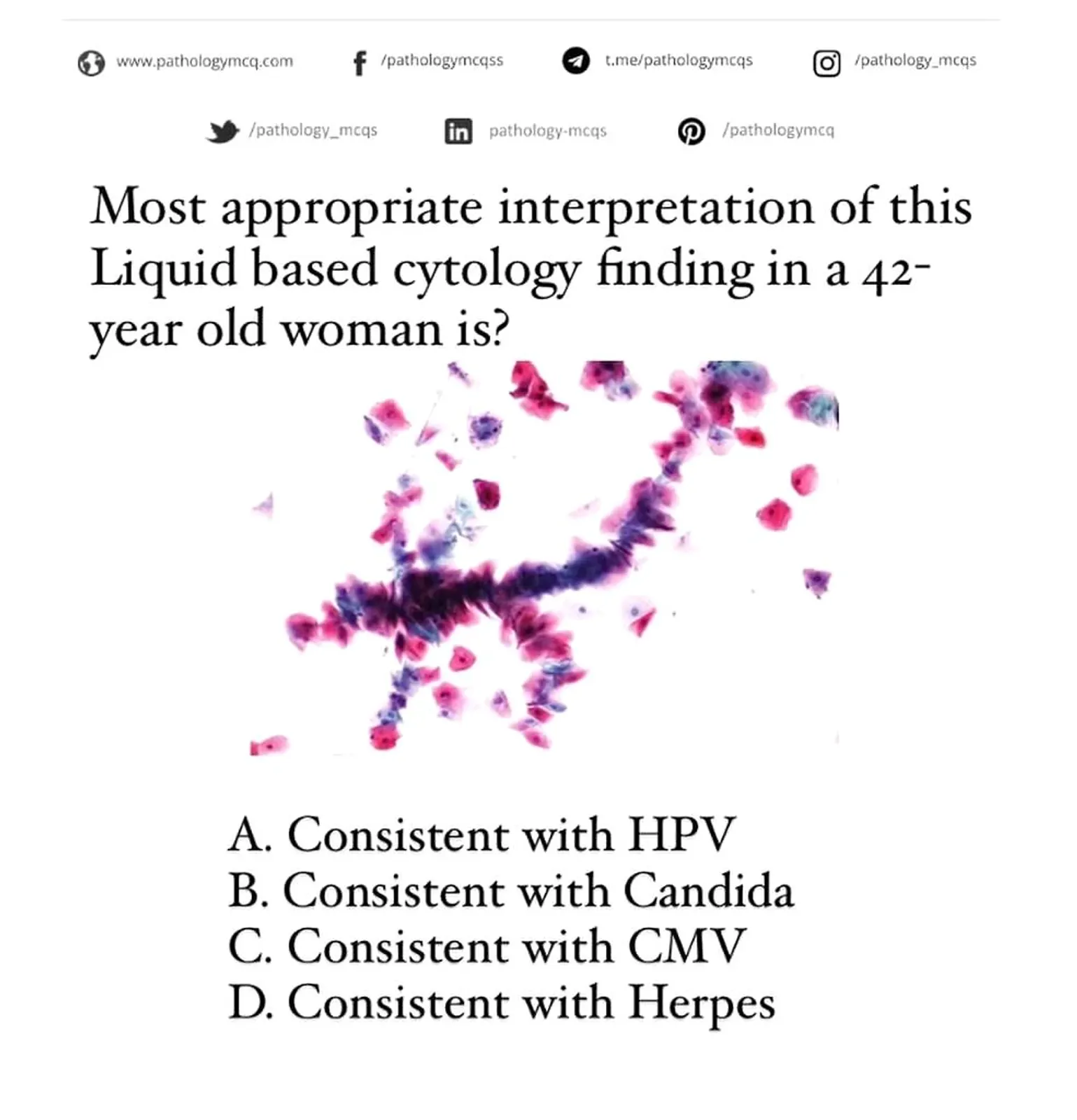
Correct answer is B: Candida
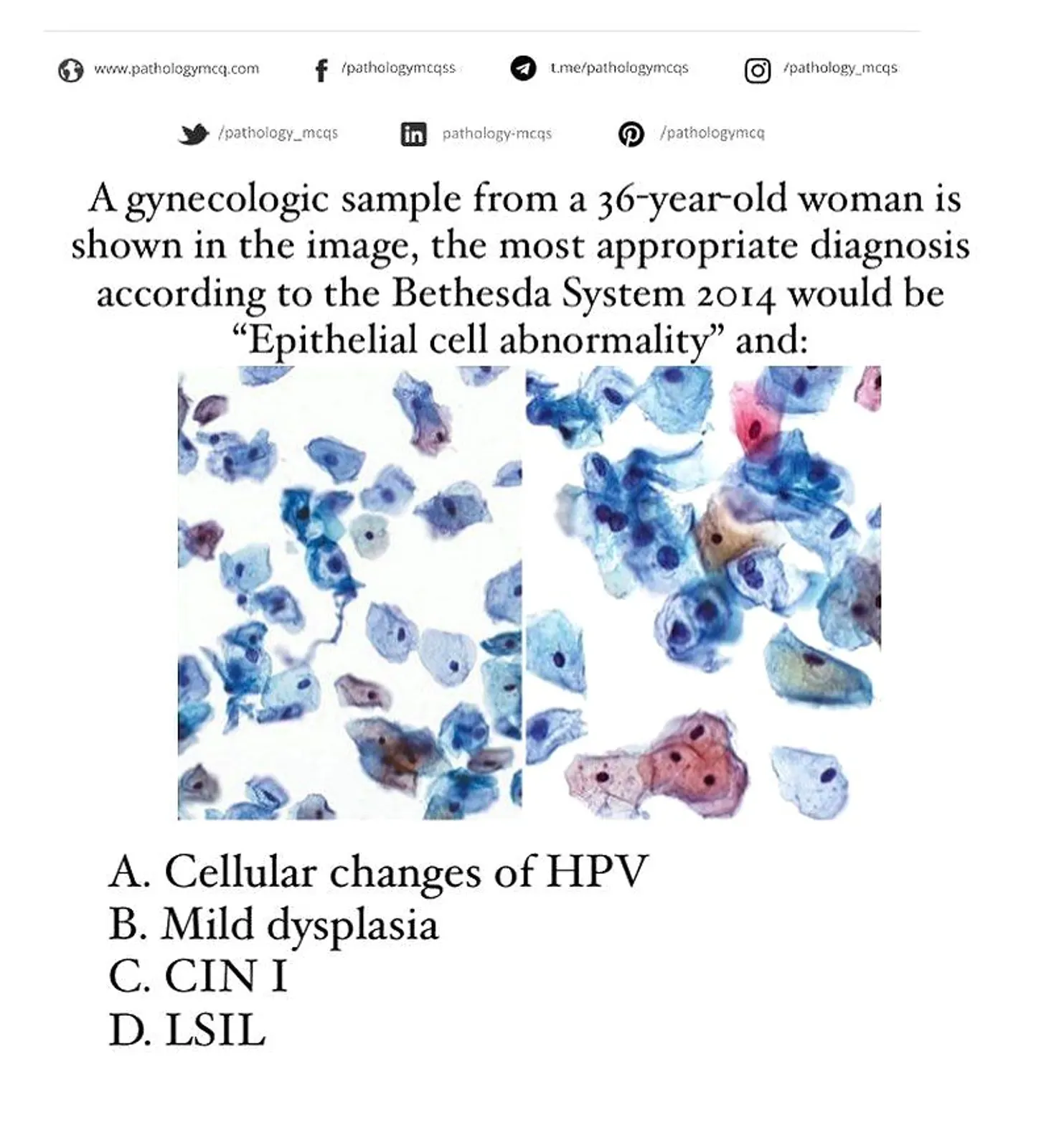
Answer is D
LSIL
According to 2014 bethesda system
Squamous epithelial abnormalities classified as LSIL encompasses HPV related changes (Option A), Mild dysplasia (Option B) and CIN 1 (Option C)
Other epithelial abnormalities according to 2014 Bethesda system for cervical cytology.
ASCUS, HSIL ( encompasses CIN II and III), suspicious for invasion and squamous cell carcinoma.
Reference: https://www.ncbi.nlm.nih.gov/pmc/articles/PMC9168399/